
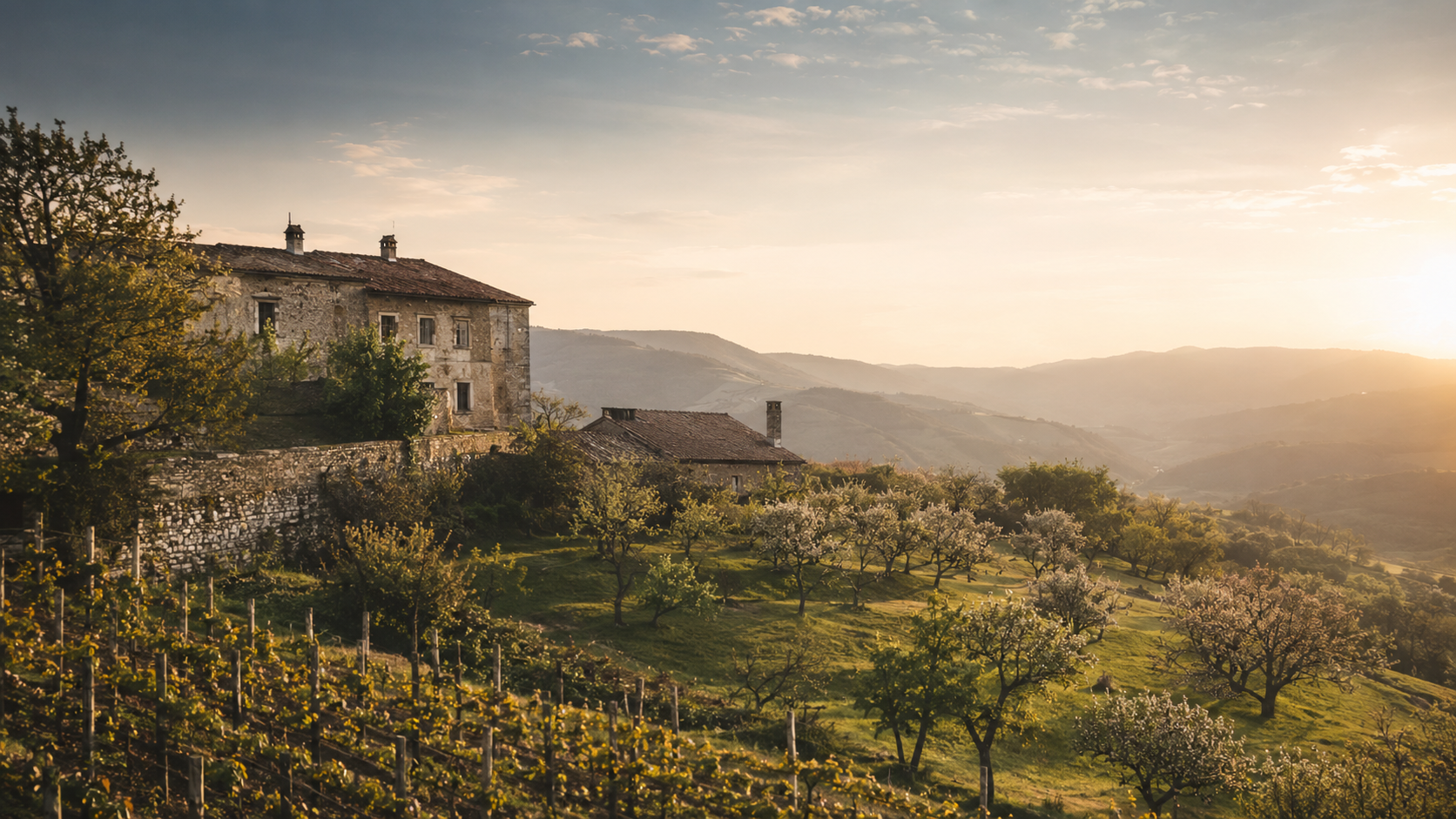
Jardii was born in the valleys of eastern Serbia — in a land where fruit is not merely seen as an agricultural crop, but as part of family history, daily life, and the identity of the people who live there. This is not the story of a brand designed in a marketing agency. This is a story of place, of soil, of hands that know what they are doing — and of a distillery that grew exactly where it belongs: in the heart of Negotinska krajina.
Brusnik — Where It All Begins
Between Zaječar and Negotin, amid gently rolling terrain that slowly descends toward the Timok river, lies Brusnik — a village whose name few hear beyond this region, but whose rakija is known by everyone who has tasted it even once. Our distillery stands right here, surrounded by orchards that know nothing of chemical pesticides or industrial logic. It is surrounded by rocks, forests, and a silence that speaks louder than any advertising slogan.
Brusnik was not chosen by chance. This part of Serbia — between the two great centres of Negotinska krajina, Zaječar and Negotin — enjoys a geographic privilege rarely encountered: a continental climate with strong Danube influence, sandy-loamy soil rich in minerals, and a vegetation cycle that gives fruit an above-average concentration of sugar and aroma. Viticulture and fruit-growing experts have long known what every local villager knows: that this land has something special. That the fruit grown here carries a flavour that is hard to reproduce anywhere else.
Negotinska Krajina — The Land of Wine and Rakija
Negotinska krajina is not merely a geographic term. It is a civilisation of taste.
This region ranks among the oldest viticultural and fruit-growing areas not only in Serbia, but across the Balkans. Archaeological finds confirm that the inhabitants of this land cultivated vines and processed fruit over two millennia ago. The Romans who passed through left traces of wine culture behind them; the Slavs who settled here built upon that tradition with their own. Every invasion, every change of power, every era — all left something in this soil, but the soil remained itself.
Rakija and wine from here were not luxuries — they were everyday life. Every household had a still. Every village had its own master distiller who knew how to extract from cherry, plum, pear, or grape what the land and sun had been building for years. The recipe was not written down — it was remembered. Passed on through scent, through taste, through conversation by the fire while the still worked.
That spirit has not disappeared. It lives in Brusnik. It lives in Jardii.
200 Years of Tradition, One Vision
When we say we blend Balkan tradition of more than 200 years with the precision of modern European brandy, we do not speak metaphorically. We speak of a concrete heritage that can be traced through generations of families in this region — a heritage that survived wars, collectivisation, transition, and globalisation, and is stronger today than ever.
In the 19th century, as Serbia slowly grew into a modern state, Negotinska krajina was one of its economically strongest regions. Wine and rakija from here were exported along the Danube, reached Austro-Hungarian and Turkish markets, and won awards at European exhibitions. Negotin wine and Negotin rakija were brands before the concept of a brand even existed.
Jardii emerges from respect for that history. But respect for tradition does not mean freezing in the past. It means understanding why the old masters did what they did — and applying that understanding in a contemporary context. Modern condensers, precise temperature control during distillation, laboratory monitoring of fermentation — none of this contradicts tradition. It is its natural continuation.
Philosophy: Respect the Fruit, Control the Process, Let Time Do Its Work
Our philosophy can be summed up in one sentence: respect the fruit, control the process, and let time do its work.
Everything begins with fruit. Not with generic raw materials, not with concentrate, not with industrial sugar. With fruit that grew on this specific plot, in this specific year, under this specific sun. Every harvest is different. Every year brings its own nuances — a little more acidic, a little sweeter, a little more aroma or a little more juice. We do not neutralise these nuances in the name of uniformity. We celebrate them.
Fermentation is the next step, and it demands patience that modern industry rarely has. Fruit ferments naturally, without accelerators, until the sugars slowly and completely convert to alcohol. This process can last days, sometimes weeks. There is no shortcut that does not leave a trace on the taste.
Distillation is an art. Every stillman knows that the most important decision is about the "cuts" — when to stop with the first fraction, when to finish with the last. That middle portion, the "heart" of the distillate, carries the purity and character that separates rakija from mere spirits. That portion demands experience measured not in years of study, but in litres of the past.
And then — time. Aging in oak or mulberry barrels transforms the distillate in a way that no chemistry can imitate. Wood gives colour, rounds the edges, adds depth. But the wood merely does the work — the rakija must allow it to. That means waiting. And waiting requires trust in the process.
Rajac — The Spirit That Feeds Tradition
One cannot speak of Negotinska krajina without mentioning Rajac — one of the oldest and most significant viticultural and wine-making villages in Serbia. Rajac is a special phenomenon: a cluster of old cellars that families built during the 18th and 19th centuries, preserved to this day as a living museum of Balkan wine and rakija culture. Every cellar has its name, its family, its story.
Here, tradition was not preserved out of sentimentality. It was preserved because it worked. Because the wine and rakija that come from this land have a character that the market rewards. Rajac is living proof that authenticity has value — and that tradition and quality do not exclude each other, but mutually strengthen one another.
Jardii carries that spirit within. Every time you open a bottle, you open a connection to those cellar masters, to those artisans who understood something two hundred years ago that the modern food industry is only beginning to discover: that the land speaks through taste, and that speech is worth preserving.
For the Modern Moment, Rooted in the Soil
We make rakija for people who value origin. Who want to know where what they drink comes from. Who understand the difference between an industrial product and a craft masterpiece. Who can sit with a glass of Jardii rakija and feel — truly feel — the Timok valley, the orchards around Brusnik, the morning mist over Negotinska krajina.
But we also make it for people who are just discovering rakija. Who may have grown up with the prejudice that rakija is merely "strong domestic booze" without sophistication. Jardii shows them another side — a rakija that can be degusted like whisky, compared to cognac, served in an elegant setting without any apology. A rakija that stands shoulder to shoulder with the finest spirits in the world, yet carries the heart of the Balkans.
That is our mission. Not to copy the West. Not to be ashamed of our origins. To show the world what eastern Serbia, Negotinska krajina, and Brusnik can offer — when tradition meets ambition, and soil meets vision.
Jardii. From Serbian soil. Into every drop.